Every diaspora relationship runs on two clocks. Meet Local Time.
Local Time shows each person's current hour and how far ahead or behind you are — right on the profile and in the chat — so timing becomes part of the connection rather than a quiet friction.
Diamour Team
August 2, 2026 · 4 min read
Built for love across oceans
Diamour is built for love across oceans — New York to Melbourne, London to Ottawa, Lagos to Toronto. When your person lives in a different time zone, connection becomes partly a matter of timing, and that small, constant calculation runs quietly under every relationship in the diaspora. Local Time is our answer: it takes the gap between your two clocks and turns it from a hidden friction into a warm, visible part of every connection.
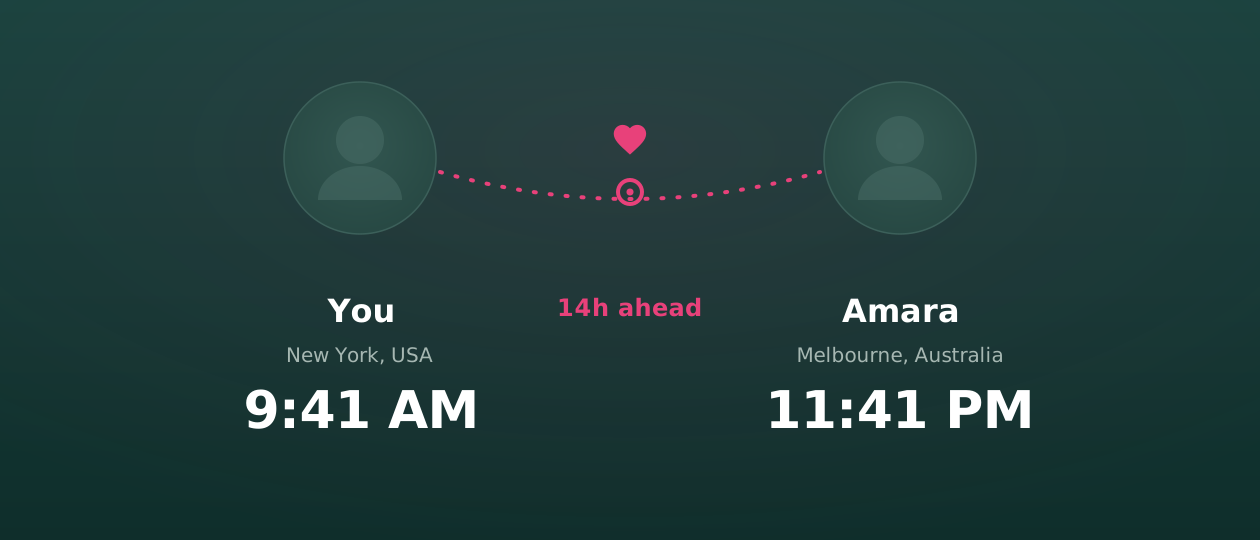
The idea shows up in the two moments it is most useful — while you are getting to know someone, and while you are talking to them. On a profile, a small card places both of you side by side: photo, city, and current local time, joined by a dashed line and a heart, with the hours between you at the centre. You · New York, USA · 9:41 AM. Amara · Melbourne, Australia · 11:41 PM. Fourteen hours ahead. It is a small, relational beat that quietly says: here is the distance, and it is crossable.
In the chat, it becomes a slim strip under the header — “It's 11:41 PM for Amara · 14h ahead of you.” It is the answer to the question every long-distance texter asks before hitting send: is this a good time? The clock refreshes on its own, and never gets in the way of the conversation.
This is a small feature that speaks directly to the diaspora experience Diamour is built around. When your person is fourteen hours ahead, “good morning” lands at their bedtime, and a quick evening call catches them at breakfast the next day. People in long-distance relationships do that math in their heads constantly. Local Time does it for them — gently, and with warmth rather than logistics — so the gap reads as part of the story instead of an obstacle standing in the way of it.
Love in the diaspora has always run on two clocks. Now the app does too.
Getting the time right — with no new tracking
Here is how it works, in plain English. Your side comes straight from your phone: your own time and offset are read from the device clock, so they are always exact — daylight saving included, with no guessing. Their side is derived from where they live. Their country, and their state for larger countries, maps to a real time zone — America/New_York, Australia/Melbourne — and the industry-standard time zone database computes their current time from there.
The gap is simply the difference between the two — “14h ahead”, “2h behind”, or “same time” — and both clocks tick live while you are on the screen. It gets the hard cases right, too. Daylight saving is handled automatically, and countries with many zones — the US, Canada, Australia — resolve by state, so Melbourne reads Australian Eastern time and Perth reads Western time, not one blanket zone for the whole country.
Just as importantly, Local Time adds no new tracking. It reuses the location already on a profile together with your own device clock — nothing new is collected to make this work. And if a location cannot be resolved to a real time zone, the feature simply hides itself rather than show a time that might be wrong. We would rather say nothing than say something fake-precise.
It was built to feel considered, and to be trusted. The card and the chat strip disappear for anyone you have blocked, and they never appear on your own profile. If a member blurs their photos, the small avatar on the card stays blurred too. And the whole thing is hand-tuned for light and dark, so it feels at home wherever you are reading. Loving across distance will always mean living on two clocks — Local Time just makes sure you never have to wonder what time it is on the other one.